
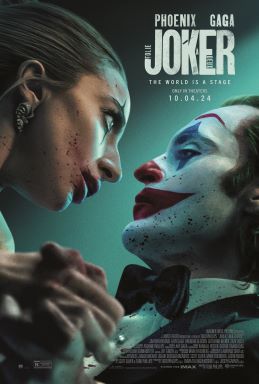
What was that film about? Joker: Folie à Deux feels like a metaphor for America’s deep political divisions—perhaps even echoing the dynamics of Trump vs. Kamala, Republicans vs. Democrats. It’s a depiction of the American dream in flames—a story of broken systems and forgotten people, perfectly aligned with Joker’s main theme: societal collapse.
I struggled to stay engaged during the first part of the film. Arthur Fleck and Lady Gaga’s character, Lee Quinzel, singing in a musical setup just didn’t make sense to me. Why a musical? I kept asking myself. The Joker appears singing in an imaginary sequence next to Lee. These fictional musical scenes are recurrent in Arthur’s head, especially in the courtroom. Witnesses’ accounts seem to trigger Arthur, sending him into a space of blackness and isolation, where he escapes by singing and dancing.
The Joker takes over Arthur’s timid and disturbed persona. His makeup is bright, and the colorful suit is on. He is now representing himself in court for the murder of five people, including the televised shooting of Murray Franklin. The Joker is brimming with confidence, defying the judge’s rules and glaring at the jury with an unsettling smile. He ridicules the witness, Gary Puddles—a fellow comedian from Arthur’s past—mocking his surname with delusional delight. The transformation is complete. Arthur is gone, and the Joker commands the room with sinister charisma. This is the moment where the film finally captures the true essence of the Joker—the chaotic, unhinged villain the audience expects—gripping our attention at last.
As echoed by an IndieWire Instagram post, the film received a largely negative response from both audiences and critics: ”‘Joker: Folie à Deux’ proves highly anticipated sequels are not immune to total disaster.” Wendy Ide from The Guardian gave the film three stars, noting that it “draws inspiration from pictures like Francis Ford Coppola’s One From the Heart and Scorsese’s New York, New York—both musicals, and, worth noting, both notorious flops.”
The film’s negative critique largely stems from Todd Phillips’ bold decision to incorporate a musical setup featuring global pop star Lady Gaga to represent the Joker’s fractured psyche. However, the film is worth a second watch. The Joker’s public trial, open to members of the public and sensationalised by the media, ties in with the film’s final plot twist. Watching it again may help unravel the true identity of the Joker and offer deeper insight into the character’s chaotic transformation.
Joker: Folie à Deux is showing in UK cinemas.
 Wladimir albuja